Frequently Asked Questions
Can I create a measure that will change the HVAC system type?
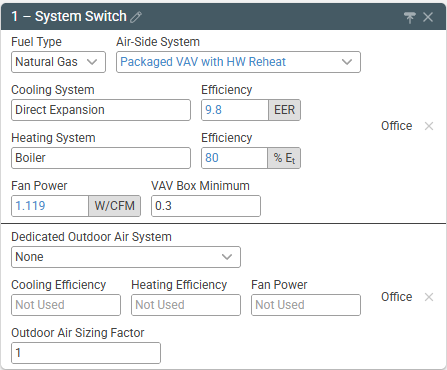
Yes, you can create a system switch measure using the custom "HVAC System Type" parameter in a user-defined measure as seen in the image below. This measure allows you to change system type, set efficiencies for the new system, and change the DOAS system type/efficiency.
How can I model an un-conditioned space?
Currently there is no built-in way to model an unconditioned space, however this is a feature on our current wish-list. As a work-around we suggest this approach:
- Design Tab
- Building Type = Parking Garage
- Air-Side System = Heating Only (Natural Gas)
- Schedule Tab
- Weekday Use Simple Thermostats = Yes
- Weekend Use Simple Thermostats = Yes (this one can be easy to miss!)
- Heating Setpoint Occupied = 0 °F
- Heating Setpoint Unoccupied = 0 °F
- Baseline Tab
- Fan Power = 0 W/CFM
How can I create a model in a city or country that isn't listed on the Project tab?
This functionality is not currently available. However if there is a location you'd like to see support, please let us know by contacting tools@slipstreaminc.org.
Can I export hourly data from Sketchbox?
Yes, hourly kWh and therms data can be accessed by going to the Results tab and clicking the “Download Results” button. If more detailed hourly data is needed, it is recommended that the user click the “Download Archive” button and import the INP and PRD files into eQuest 3.64. From there, more detailed results can be extracted from the model.
How should lighting controls savings factors be applied?
The Sketchbox team developed default lighting controls savings factors by reviewing industry accepted lighting control studies and technical reference manuals. The occupancy control "better" savings factors represent savings from zone-based occupancy controls, whereas the "best" savings factors represent savings from luminaire level lighting controls. For building types where reliable data was not available, derating factors were applied to known savings factors to determine appropriate values.
Task tuning "best" savings factors represent typical savings from task tuning independent of other lighting control strategies. Where referenced studies provided savings factors for retrofits, a derating factor was applied to approximate savings in new construction buildings.